By Jeremy Appel, Local Journalism Initiative Reporter
(ANNews) – The Assembly of First Nations (AFN) is backing the cross-border Jay Treaty Alliance’s criticism of a recent Canadian government travel advisory urging First Nations people to carry a Canadian passport when entering the U.S.
Article III of the 1794 Jay Treaty between the U.S. and what was then British North America guaranteed free cross-border travel for U.S. citizens, British subjects and “the Indians dwelling on either side of the boundary line,” in addition to exempting Indigenous travellers from duties and taxes on “their own proper goods” when crossing the border.
According to Pine Tree Legal Assistance, a non-profit law firm based in Portland, Maine, anyone from Canada who has more than 50 per cent “Aboriginal blood” can travel to or work in the U.S. without a U.S. visa or Canadian passport.
Instead, U.S. border security can ask for any combination of a blood quantum letter, status card, long-form birth certificate, or photo ID.
On Feb. 19, the federal government updated its travel advisory website to say that First Nations people “may be able to cross the Canada-U.S. border by land or water” with their status card.
“However, the acceptance of all status cards is entirely at the discretion of U.S. officials,” reads the advisory, which “strongly recommended” First Nations people also carry a Canadian passport.
According to an archived version, the website previously stated that First Nations people “may freely enter the United States for the purposes of employment, study, retirement, investing, or immigration.”
The AFN urged caution for First Nations band members crossing the border after a First Nations man was detained during an Immigration and Customs Enforcement raid. According to reporting from the Canadian Press, he had his status card seized and was deported.
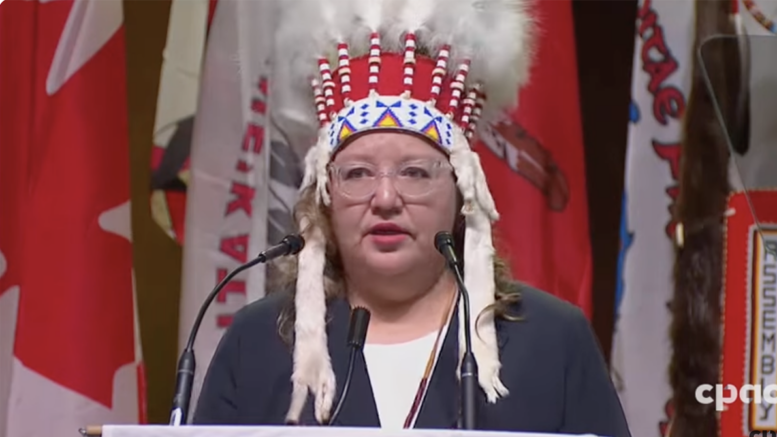
In a Feb. 26 statement, AFN Grand Chief Cindy Woodhouse Nepinak said that the new travel advisory runs “directly counter to the inherent right of First Nations” to travel freely between the U.S.-Canada border, as stipulated by the Jay Treaty.
“This right recognizes that First Nations moved freely through our traditional territories for ceremony, for trade, for harvesting and for family. That right must be recognized and upheld by governments on both sides of the border which was not our making,” said Woodhouse Nepinak.
Requiring First Nations people to use Canadian passports, she added, “undermines our inherent right and the principle of self-determination.”
A few days earlier, the Jay Treaty Border Alliance (JTBA) issued a statement to express its “profound disappointment” with the travel advisory, calling the right to travel freely across traditional Indigenous lands “paramount.”
The JTBA is a collaborative initiative between First Nations and tribal governments on both sides of the Canada-U.S. border to uphold their mobility rights.
Its leadership consists of Chief Michael L. Conners of the St. Regis Mohawk Tribe in New York State, chairwoman Jennifer Porter of the Kootenai Tribe of Idaho, Regional Chief Abraham Benedict of the Chiefs of Ontario, and Grand Chief Cody Diabo of the Mohawk Council of Kahnawake in Quebec.
In addition to acknowledging the inherent rights of First Nations, the JTBA is asking the Canadian government “to specifically affirm the right of American born First Nations citizens to enter Canada.”
“The creation of the border imposed lasting divisions on Indigenous Nations, in many cases permanently separating families and communities. The Alliance urges Canada to work directly with First Nations to address all violations, including those imposed by both the United States and Canada,” the JTBA statement reads.
In 1956, the Supreme Court of Canada ruled that the Jay Treaty was unenforceable on the Canadian side of the border, since it was never ratified by the Canadian parliament.
This means that the Canadian government only recognizes the right to travel freely into Canada and the U.S. for members of First Nations registered under the Indian Act, not members of tribes based in the U.S.
The JTBA statement calls on the Canadian government “to correct this inequity.”
The Mohawk Council of Akwesasne (MCA), which sits on the borders of Ontario, Quebec and New York, issued its own news release, noting that its members’ “mobility across this territory does not depend on Canadian citizenship documentation but flows from who we are as a people and must be upheld.”
“While documentation establishing Indigenous status may be required when interacting with border agencies, no travel advisory can override the rights of Akwesasronon to move freely within our territory,” said MCA Grand Chief Leonard Lazore in a Feb. 26 statement.
Global Affairs Canada didn’t respond to Alberta Native News’s inquiry by deadline.

Be the first to comment on "AFN criticizes travel advisory for First Nations people entering the U.S"