By Chevi Rabbit, Local Journalism Initiative Reporter
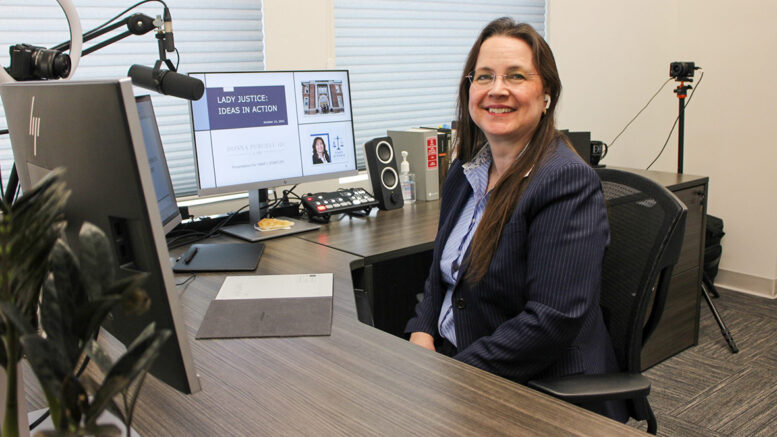
(ANNews) – As debate over Alberta’s potential separation from Canada continued, lawyer Donna Purcell, KC, and strategist Jacqueline Biollo organized a public forum in Central Alberta on Oct. 16 to bring their concerns about public division and the need for informed discussion to the forefront.
In an interview with Alberta Native News, the two organizers explained why they wanted to bring people with differing perspectives together, to encourage respectful dialogue and help Albertans make informed decisions about the province’s future.
Donna Purcell: Encouraging Albertans to speak to one another
Purcell said her involvement grew from conversations with members of the public at a market at Red Deer Polytechnic, where she had been sharing information about her concerns regarding Alberta separation.
She said she wanted to provide an alternative perspective after hearing arguments in favour of Alberta leaving Canada.
“I know, free speech is great, I’m a big proponent of that, and they had some people from Let’s Talk Alberta, and there was my MLA, or one of the MLAs from South Red Deer there for a while speaking in favor of separation,” Purcell said.
“So I felt it important to counter that with the pro-stay in Canada viewpoint.”
Purcell said people she spoke with appreciated the opportunity to discuss the issue and access information from a different perspective. She believed there was a need for a space where Albertans could ask questions without feeling that they had to take sides before understanding the issues.
She described the atmosphere surrounding the separation debate as one in which people on opposing sides had expressed concerns about their future.
“You’ll hear one side say, you know, we’re getting death threats, and the other side feeling like their land’s being stolen away from them, or their pension, or their future, and that they don’t feel like they have any power in all of this,” she said.
For Purcell, the purpose of the forum was to help people feel empowered to participate in the conversation rather than become further divided. “I’m just trying to empower central Albertans to feel that they can speak up and speak to each other, not across each other,” she said.
A civil litigator with decades of experience, Purcell said her interest in history also shaped how she viewed separatist movements and the circumstances that can lead people to consider independence.
“I’m involved with the legal archives, and I look into historical trends and other places throughout the world to see what happens to make somebody want to separate from their country and feel that their only route is to independence,” she said.
Purcell said economic frustrations could contribute to polarization, particularly when people begin looking for someone to blame. “And I see that in those kinds of times society [can] become polarized, like we are now,” she said.
While acknowledging Alberta’s economic development challenges, Purcell said she believes collaboration offers a more productive path forward than confrontation.
“And I feel that, yes, we have economic development issues, but collaboration is my route to problem solving and not yelling at each other, which is somehow what I feel happens to me when I try to discuss this with certain people,” she said.
Purcell also raised questions about how Alberta separation could affect Indigenous treaty rights, land and access to waterways. “So there are treaty rights, and, you know, those have to be respected,” she said.
She questioned how a separation proposal would address Indigenous lands, national parks and major urban centres if different areas were subject to different jurisdictions.
“And so if there are people that want to separate, are we going to, you know, take out Indigenous land, take out national parks, maybe take out Calgary, Edmonton, and Red Deer, and have a Swiss cheese piece of separation?” she said.
Purcell also questioned how people would navigate boundaries and access waterways under such circumstances. The legal implications would depend on the details of any separation proposal and the applicable constitutional and legal frameworks.
Her broader concern was how people could share the land while respecting existing rights and obligations. “I mean, if you take it to this idea that somehow, I don’t know who owns the land, but we definitely are sharing them, and we all need someplace to live,” she said.
Purcell attended law school at the University of Calgary and worked as a civil litigator across industries and types of litigation. Her career included work at law firms in Calgary and Edmonton, followed by more than 25 years at a business law firm in Central Alberta. She later established her own cloud-based legal practice, with a head office in Red Deer County and offices in Red Deer, Edmonton, Calgary and Sylvan Lake.
She described herself as a mother, lawyer and Chief AI Architect at her law firm.
Jacqueline Biollo: Making room for different voices
Biollo, who worked with Purcell as a strategist, said the forum was organized to give Albertans a better understanding of the arguments surrounding separation and encourage them to participate in the democratic process.
“Well, I think the most important is obviously we’re just looking for additional voices to speak up, give Albertans an understanding of both sides of the conversation, to be perfectly fair,” Biollo said.
She said the organizers wanted to encourage participation while remaining open to different perspectives.
“So, you know, on one hand, we were trying to be non-partisan, even though we have our own opinion, but at the end of the day, we wanted to encourage people to get out and vote,” she said.
Biollo said Albertans were encountering competing messages about the province’s future, including political signs and third-party advertising. She wanted the forum to give people an opportunity to hear directly from those with differing viewpoints.
“But what Donna and I have been really trying to organize is having these voices come together,” she said.
Although the event could be described as a debate, Biollo said the intention was to create a discussion rather than a confrontation between opposing sides. “Now lots of people can talk about it being a debate, but it’s actually a discussion,” she said.
She explained that people should have an opportunity to present their views, support their positions with examples and answer questions from others. “It’s that we were inviting everybody to come and have a voice,” Biollo said.
She said the approach was intended to help people understand why others held particular positions, even if they did not ultimately agree with them.
“You know, if you want to try and convince me to vote one way or another, then give me the facts, right? Give me maybe your opinion or some specific examples that I can go, Oh yeah, okay, that makes more sense,” she said.
For Biollo, the goal was not simply to give people a platform to argue. It was to help them leave the discussion better informed and more motivated to participate in the referendum debate.
She said the organizers wanted attendees to have the opportunity to ask questions, consider different arguments and decide for themselves how they would participate in the democratic process. “So again, a lot of this was really get out and vote,” she said.
Through the Oct. 16 forum, Purcell and Biollo sought to create an opportunity for Albertans to engage with differing perspectives on separation. Their interviews emphasized the importance of public discussion, access to information and respectful dialogue as people considered Alberta’s future.

Be the first to comment on "Alberta Separation Forum Aimed to Bridge Divides Through Public Dialogue"