By Chevi Rabbit, Local Journalism Initiative Reporter
(ANNews) – For Daniel Foreman, storytelling has been a lifelong practice. But after years of making films and helping create opportunities for independent filmmakers, he says he has come to understand something even more deeply: Indigenous people need opportunities to tell their own stories.
“That’s the thing that gets me every year,” said Foreman, founder and president of the Edmonton Short Film Festival. “The older I get, the more I understand how important it is that Indigenous people have the opportunity to tell their own stories.”
Foreman, who identifies as Métis from Region 4 of the Métis Nation of Alberta, has been making Indigenous-themed films for approximately 15 years. He co-founded the Edmonton Short Film Festival with Sharlene Millang Borst in 2012.
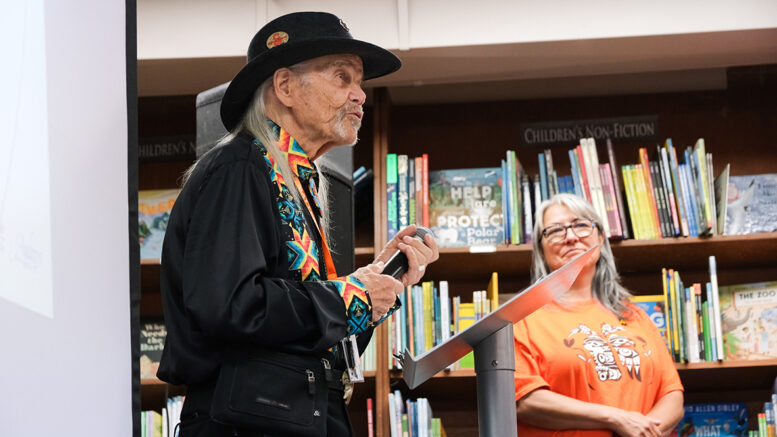
On September 30, the festival will partner with Audreys Books for its third annual Truth & Reconciliation Pop-Up Screening and Author Event, bringing together Indigenous filmmakers, authors, Elders and community members.
The free event will take place at Audreys Books, 10702 Jasper Avenue NW in Edmonton. A smudge led by Elder Terry Lusty is scheduled for 4:30 p.m., followed by the official program at 4:45 p.m. Elder Dan Cardinal will provide the closing prayer. The program will feature two Indigenous authors and two Indigenous filmmakers, with each presentation followed by a question-and-answer session. Registration is required because space is limited.
For Foreman, the event is about more than screening films.
The participating authors do not necessarily focus specifically on Truth and Reconciliation. Instead, Foreman said, their work provides an opportunity for people to encounter Indigenous perspectives they may not have experienced before.
“This is more of an overview – just to introduce people who may not have seen or heard of Indigenous authors, and just kind of introducing them to that viewpoint in the whole scope of Truth and Reconciliation,” he said.
That visibility is particularly important for independent creators, Foreman said. “It’s a challenging environment for anyone to break out in,” he said. “So this gives them a space to promote their work and get in front of a local community.”
Creating that space was part of the original motivation behind the Edmonton Short Film Festival. Foreman said he and Millang Borst experienced firsthand how difficult it could be to get independent work in front of the public.
“We were having a difficult time getting our work screened in front of the community, in front of the general public,” he said.
Today, Foreman sees pop-up screenings as another way to address that challenge. “We use these pop-up screenings, like at Audrey’s, to help amplify Indigenous voices,” he said.
The event also creates a different kind of film-screening experience. Rather than beginning with a conventional introduction and immediately moving into a screening, the gathering incorporates ceremony, Elder teachings, literature, film and conversation.
“We’re bringing in authors, and we’re doing it inside a bookstore, which is kind of a unique spot to have a film screening,” Foreman said.
Looking beyond September 30, Foreman believes film festivals and independent filmmakers can continue contributing to reconciliation by creating opportunities to listen and learn – particularly across generations.
“I think it’s teaching the youth more than anything,” he said. “Having Elders come and talk about their experiences and what this means and how we can reconcile with this and how we can grow and move forward is really important.”
Foreman said that learning is not something he considers finished. “There’s a lot of things I didn’t know growing up, and I’m still learning,” he said. “I learn from Elders all the time and community members.”
That spirit of learning is central to what he sees happening in the room during the event. “You’ve got an Elder sharing knowledge, a filmmaker sharing something they put their heart into, an author talking about where their stories come from, and then you look around and you see Indigenous and non-Indigenous people sitting together, listening,” Foreman said.
“They’re laughing. They’re asking questions. They’re learning from each other.”
For Foreman, that exchange is part of a much larger story.
“A lot of our Indigenous history was missing from what many of us were taught,” he said. “And there are stories from our parents and our grandparents and communities that weren’t being heard, and this is an opportunity to kind of hear those stories.”
After a lifetime of telling stories, Foreman said the importance of Indigenous people telling their own stories has become increasingly clear.
“For a very long time, other people told our stories for us, or our stories weren’t even told at all,” he said.
The September 30 gathering offers one response: bring the storytellers, authors, filmmakers, Elders and community together, create space to listen, and allow those stories to be heard directly from the people who carry them.

Be the first to comment on "Edmonton Short Film Festival Brings Indigenous Voices Together for Truth and Reconciliation"