
by Chevi Rabbit, Local Journalism Initiative News
(ANNews) – For Al Crawford, being a role model is not about presenting a perfect image. It is about being honest about where he has been, the choices he has made and the lessons he continues to learn.
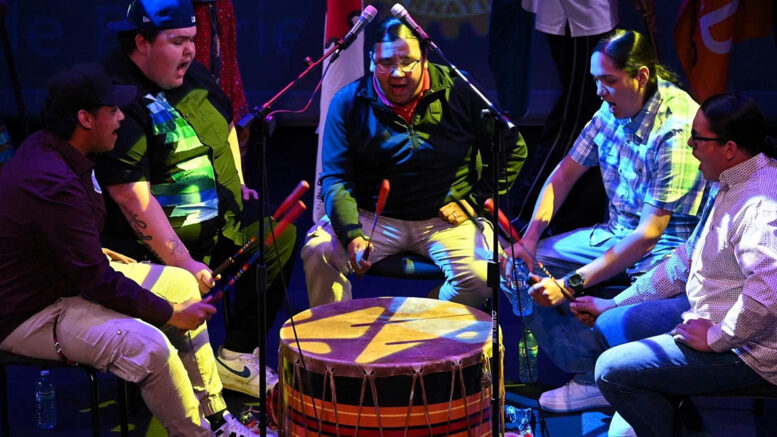
A member of Bigstone Cree Nation from Wabasca, Alberta, Crawford has spent more than eight years developing his work as a public speaker. He is also the lead singer of Red Elk and says he has spent roughly 15 years learning, singing, travelling and growing through his relationship with the drum.
“My role as a public speaker is what I’ve used over the last eight-plus years,” Crawford said. “I’m also the lead singer of the drum group Red Elk, and I’ve spent the last 15 or so years learning, singing, travelling and being on the drum.”
His work with young people is rooted in a simple message: a person’s circumstances do not have to determine their future.
“When I speak to youth, it always comes from a place of, ‘If I can do it, so can you,’” he said.
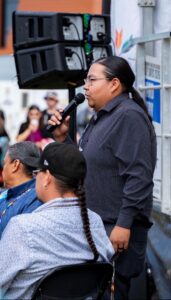
Screenshot of Al Crawford.
Crawford grew up in northern Alberta and remained in his community until he was 16, later leaving for high school. He eventually entered the human services field in the Grande Prairie area, working with youth in care and group-home settings.
Those experiences helped shape his approach to mentorship and public speaking. Rather than portraying himself as someone who has always made the right decisions, Crawford embraces his imperfections.
“I’m not only a role model; I’m a real model who has flaws,” he said. “I make mistakes. I’ve burned bridges. I definitely haven’t always made the right choice.”
For Crawford, acknowledging those mistakes is part of the message. “I think it’s about learning from those experiences — not only learning about who you are, but understanding that regardless of where you come from or what your circumstances are, you can still live a positive, beautiful lifestyle.”
That perspective has also led Crawford to become passionate about men’s wellness and the importance of positive male role models. He has spoken openly about growing up without his biological father for much of his life. From the age of seven until his father’s death last year, other men — including his grandfather, uncles, friends and other community members — helped fill important roles in his life.
“I’m very passionate about men’s wellness and being an advocate for men’s health because, like many others, I’ve had people like my late grandfather, my uncles, my friends and their dads fill that role of the male figure in my life,” he said.
That experience helped shape his understanding of what young men need. “I’m always mindful that our young men are struggling. Our young men are very isolated within themselves. It’s not just the external pressures of society and the world around them, but also the internal battle that we all fight in wanting to be a better man, a better son or a better dad.”
His own circumstances encouraged him to become a positive influence for his younger siblings and other young men he encountered. “Not having my biological father there for so many years really shaped me to become a role model for my younger siblings. I was almost like a father figure to them.”
Crawford believes mentorship is especially important for young men who grow up without healthy male figures in their lives.
“Many of us are raised by our matriarchs — our moms, our grandmas and our aunties — but it really takes a man to raise a man,” he said.
Mentorship became particularly meaningful through his relationship with Wally Poches of Paul First Nation, whom Crawford describes as an adopted father and important mentor.
“He really took me under his wing and invited me not only into life as a young man, but also into ceremonial spaces,” Crawford said. “He brought me into those ceremonial spaces so that I could truly put those prayers forward and pray for a better life.”
For Crawford, mentorship and spirituality can provide young men with tools to make healthier choices.
“I’d say mentorship and spirituality are the big keys for a lot of our young men in communities,” he said. “They’re missing those things, and both are very vital in being a positive figure and having the capacity to make better choices.”
Another important part of Crawford’s message is challenging narrow ideas about masculinity. He believes young men need permission to be vulnerable, compassionate and emotionally open without believing that vulnerability makes them weak. “I had to learn how to navigate when to cry, when to be vulnerable, when to be fierce and strong, when to advocate and how to interact with people,” he said. “But when it comes to wanting to better ourselves, we have to relearn that piece of compassion.”
For Crawford, learning to cry again became an important part of his own wellness journey. “One thing I’ve learned in my young life is how to cry again,” he said. “Many of our young men, when we struggle, we internalize it. We don’t allow ourselves to express what we’re feeling.”
He connects emotional expression to music and cultural connection. Crawford recalled a teaching about nikamo, meaning “to sing,” and how singing can be understood as a form of expression and healing.
“Singing is not only a form of self-expression; it can also be a literal way of healing for men, for women and for all our people,” Crawford said. “When we don’t have a connection to culture or ceremonies, we still have a connection to music, whether it’s mainstream music or other forms of traditional music.”
That connection between culture, wellness and community is reflected in Crawford’s work with the drum and his involvement in Indigenous men’s wellness programming. In Edmonton, he has shared teachings around the powwow drum as part of an Indigenous Men’s Wellness Group, helping create a space where Indigenous men can gather, connect and learn.
Crawford also believes there is room for humour in conversations about healing and wellness. “People love to laugh,” he said. “Humour has been one of my strongest assets when I speak. Not only can I make people laugh, I can laugh at myself.”
For him, laughter is another way of building connection and reminding people that life can still hold joy while they are working through difficult experiences. “When you can be vulnerable and share those experiences, people see that and think, ‘Okay, I can lead a life where I can be a strong man and a strong warrior, but I can also be vulnerable when I need to be.’”
Ultimately, Crawford wants young people to understand that their past does not have to define their future. “There’s always an opportunity to create a meaningful life if that’s what you choose to do,” he said.
His message is one of responsibility, compassion and hope: find people who can guide you, follow your gifts, take care of yourself and be willing to show up honestly.
“We have people that rely on us,” Crawford said. “So take care of yourselves and continue the work to be that positive light in someone’s life.”

Be the first to comment on "Learning to Be Strong and Vulnerable: Al Crawford’s Message to Indigenous Men"