
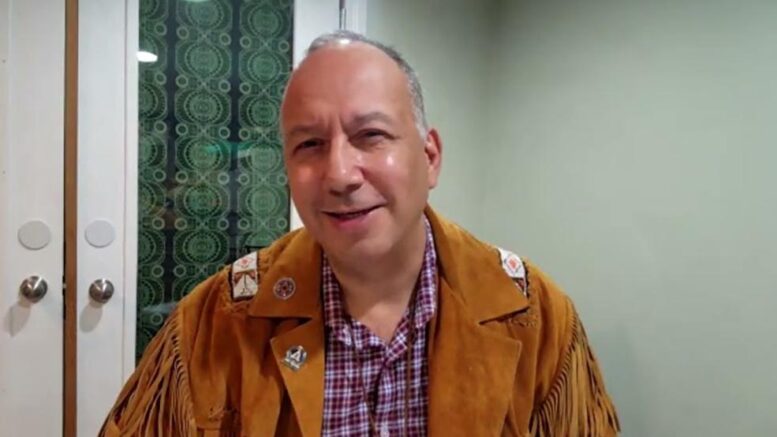
By Chevi Rabbit, Local Journalism Initiative Reporter
(ANNews) – For Kerry Gladue, recovery is not simply about becoming sober. It is about learning to live differently, rebuilding relationships, reconnecting with family and finding a sense of belonging.
Born and raised in Edmonton, Gladue is the oldest of three children on his mother’s side. His mother was a residential school survivor who grew up at St. Bernard Mission in Grouard, Alberta, while his father was from Fort McMurray.
Gladue also carries the Indigenous name Shaganappi, meaning “rawhide rope.”
Looking back, Gladue now understands that as a child he was living with circumstances he did not have the words or perspective to understand.
“I understand that [I] was affected by intergenerational trauma, a lot of addiction issues and being in an unhealthy environment, and that affected me in life as I got older into adulthood,” he said.
Those experiences eventually brought Gladue into the child-welfare and justice systems. He experienced different stages of the system, from juvenile and young-offender involvement through adulthood and provincial and federal institutions.
But today, he views those experiences as part of the knowledge he uses to help others. “I accept what it was, and I understand now that if it wasn’t for these experiences, I wouldn’t be doing what I am doing today. I wouldn’t have the knowledge and experience to do that.”
His experiences allow him to connect with people regardless of where they are in their lives. “I can meet people where they’re at in any part of their life, and I can sit at any table, being at a professional level, or just sitting there with a brother and sister and shooting the shit, so to speak.”
The moment that everything changed
Gladue’s turning point came during one of the darkest periods of his life. Sitting in a jail cell, he was grieving the deaths of his mother and sister and the loss of his relationship with his children. “I was so broken. I was grieving with the death of my mom, my sister. I was grieving my children not being in my life.”
For years, he had promised himself that if he could get another chance, he would change. But in that cell, he reached a different kind of realization. “I was just sick and tired of being sick and tired. I knew something had to change.”
Gladue describes praying and opening a recovery Bible while alone in his cell. He was facing the possibility of an 11-year sentence and had more than 300 charges.
The circumstances had not changed, but hope entered the picture. “It didn’t change the fact that I was probably going away for 11 years. I had over 300 charges. But that little feeling that gave me hope is what I needed in my life.”
“I had nobody. I was all alone in the world, and it was a really dark place to be.”
That moment became the beginning of a new way of thinking. Gladue entered the Calgary Drug Treatment Court program after being denied entry into Edmonton’s program because of the number of charges he faced. Calgary gave him an opportunity to participate in treatment.
He credits the program, along with Simon House, with teaching him accountability and giving him the opportunity to rebuild. “I was taught to look at myself. I was taught to be accountable, accepting of what I’ve done, and to move forward in my life and do the work.”
Simon House became an important part of his recovery. “Simon House is where I grew up.”
He also began seeing the justice system differently. People he once feared or resented were now part of a team helping him change his life. “The team that put me together are the people that I dreaded growing up. They’re the social workers. They’re the police. They’re the prosecutors. They’re the judges. They’re the cops. All these people got together, came up with a plan, got me out of jail, the people that usually put me in there.”
For Gladue, recovery also became spiritual. “I learned that Creator was always there. The Creator was always there trying to help me. I just was too sick to see.”
He learned that some of the most difficult choices could also become the most transformative. “Because it seems the most uncomfortable things have been the life-changing things.”
Changing what feels normal
Gladue describes his former life as one in which chaos had become comfortable. “My new norm was chaos in my old life, where it was comfortable, where other people, normal people, wouldn’t be comfortable. It was my comfortable.”
Recovery reversed that. “And that shifted all the way to the opposite, where that life is very uncomfortable for me, and I can walk away from it and be at home with my daughter and our cat.”
That new life has also meant rebuilding his relationship with his children and working to make amends for mistakes made while he was in active addiction.
Today, Gladue is turning his own experiences into programs designed to help others.
Building the next stage of recovery
After approximately 14 years working throughout the recovery sector, Gladue became a certified addictions counsellor and certified sex addiction specialist. He is now the founder and CEO of Shaganappi Recovery Solutions. His work includes addressing trauma and cross-addictions, including subjects that many people find difficult to discuss. “Another uncomfortable subject, right? Like I said, who wants to talk about that?”
Gladue also saw a gap in the recovery system: what happens after detox and treatment? People can complete treatment and still return to the same environments that contributed to their addiction. “They went to treatment, and then where did they go after? They had no choice to return back into the chaos and the lifestyle that they tried to escape.”
His response is supportive sober living. “My program offers a place, a structured place, where they can start rebuilding.”
Residents are expected to work on their recovery every day through meetings, counselling, therapeutic activities, employment and other recovery-oriented goals. “The expectation is when they come in that they do something every day to better their recovery, to better their life.”
Gladue says the approach is already producing results. “I’ve been blessed to have people returning to work that haven’t worked in years.”
Honouring Grandma Jeannie
One of his supportive sober-living initiatives is Grandma Jeannie’s House, named after his late mother. Known as Grandma Jeannie or Cookum Jeannie, Gladue’s mother was a residential school survivor who experienced trauma and addiction. Yet she became a matriarch who cared for family and provided a safe place for her children and grandchildren. “I wanted to honour her.”
The home is intended to provide that same sense of safety and belonging. Residents can reconnect with family, spend time with their children and work toward reunification. For Gladue, recovery means more than sobriety. It means having a safe place to live, building relationships, finding community and learning that you belong.
From a jail journal to the big screen
Gladue never expected to write a book. Years into his recovery, while working at a treatment centre, he found an old journal he had written while in jail. “I was already like five years clean. I was working in a treatment center, and I was like, who the heck’s this guy? Like, the guy sounded terrible, and that was my writing. That was me.”
As he began revisiting his past, he also began speaking publicly about his experiences, including sexual abuse he experienced in foster care.
People began approaching him privately after his talks and sharing their own experiences. “I had people coming up to me and sharing with me in confidence that it’s the first time they’ve ever shared this, but it happened to them too.”
He realized his story could reach people beyond the rooms where he spoke. The result was Second Chances: The Kerry Gladue Story.
The next step from a book was a movie. A screenplay based on his life is being developed under the title Shaganappi. Gladue says an A-list actor has committed to the project, pending funding and the right production partners.
For Gladue, the evolution from journal to book to film is about reaching more people with a message of hope. His story is ultimately not about erasing his past. It is about accepting it, learning from it and using what he experienced to help someone else.
He continues to thank his children, the Calgary Drug Treatment Court, Simon House Recovery Centre and the agencies supporting his programs. He also recognizes the work being done by First Nations communities and leaders creating solutions despite the challenges they face.
After surviving addiction, incarceration, trauma and profound loss, Gladue has built a life centred on recovery, family and service. For Gladue, the difficult experiences of his past have become part of the purpose of his present. His story has become one of second chances – but also of recognizing the people, opportunities and possibilities that can appear when someone is finally ready to see them.
“Creator will come through for good people doing good things always.”
For more information about Shaganappi Recovery Solutions, visit shaganappirecoverysolutions.com

Be the first to comment on "From Chaos to Belonging: Kerry Gladue Turns His Second Chance Into a Path for Others"