
by Troy Dumont, Local Journalism Initiative Reporter
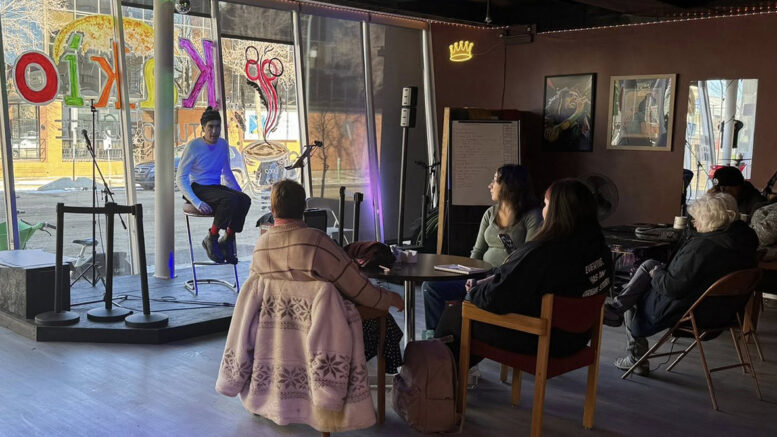
(ANNews) – Participants gathered at Kakio Studio Café on April 16 for a hands-on pitching workshop hosted by the Dreamspeakers International Indigenous Film Festival, where filmmaker and producer Joshua Jackson guided prospective creators through the fundamentals of presenting their work to potential producers and investors.
Jackson structured much of the session around the practical differences between a short elevator pitch and a longer presentation. He described the elevator pitch as a tool for quickly conveying the core of a project, clear, concise, and memorable, particularly in situations where time is limited. A longer pitch, he said, gives creators room to build on the story, establish tone, and outline where the project is headed. Throughout the session, Jackson pushed participants to lead with their strongest hook and resist the urge to front-load their pitches with context and setup.
A key concept the workshop returned to was the MDQ, or major dramatic question, which Jackson described as the central tension that gives a story its momentum. He challenged participants to identify the driving conflict in their projects and to let that question anchor their pitch, rather than burying it beneath a plot summary.
The session also emphasized two questions Jackson said every filmmaker should be prepared to answer: why this story, and why now. He framed those questions as bridging the creative instinct behind a project and the professional case for making it, an argument for its relevance and why it deserves attention now.
“If someone believes in you, they are more likely to believe in your work,” said Jackson.
Confidence was a recurring theme. Jackson told participants that industry contacts and investors evaluate the person making the pitch as much as the project being pitched. Presenting with clarity and conviction, he said, is as important as the idea itself.
The session felt more like a working conversation than a lecture. Participants tested out their ideas, heard one another’s pitches and received immediate feedback. Jackson reshaped participants’ ideas in real time, pushing them to name the hook, tighten the language, and be clearer about the story they wanted to tell.
Among the participants was Troy Grey Wolf, who serves on council for his nation near Fort St. John. Grey Wolf said the workshop was important to him because film work can feel distant from the north, stating, “Where I am, it’s isolating, and a lot of these things I don’t really have access to.” Grey Wolf’s pitch showed that empowering indigenous voices is a celebration as much as an act of cultural preservation. He was drawn to the festival because Indigenous filmmakers are increasingly telling their own stories from their own perspective rather than having those stories told for them.
The workshop was one of several events held as part of the Dreamspeakers International Indigenous Film Festival, produced by the Dreamspeakers Festival Society. This registered non-profit has been presenting Indigenous film, video, and new media from around the globe since 1993. The festival connects filmmakers, media artists, and industry professionals while celebrating the diversity and excellence of Indigenous art and culture.

Be the first to comment on "Workshop teaches Indigenous filmmakers how to pitch their stories"