
By ANNews staff
(ANNews) – A new title published by University of Alberta Press links the art of map-making with Indigenous storytelling and gives a fascinating look at Blackfoot cartography from the early 1800s. At its core, it ties the Blackfoot people to the vast Alberta landscape.
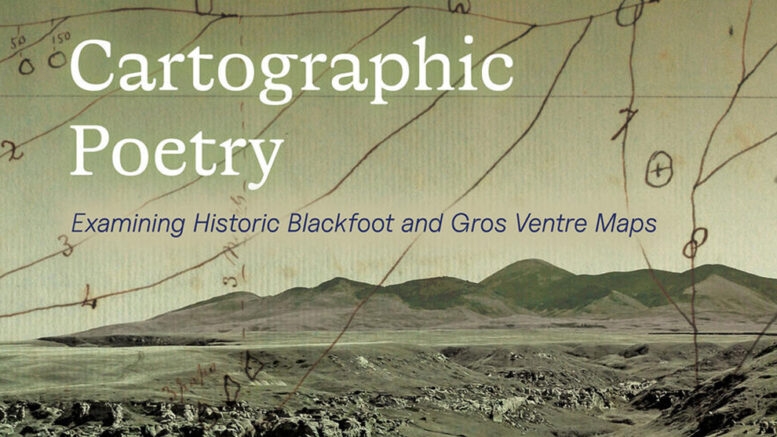
Cartographic Poetry is the first book-length, multidisciplinary study of five maps drawn in 1801 and 1802 by several Blackfoot and Gros Ventre people for the Hudson’s Bay Company. Representing some of the oldest documents created by Indigenous people on the North American prairies and foothills, these maps preserve invaluable evidence about places on the landscape, and about historic Blackfoot views of their territories.
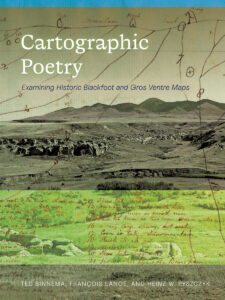 The maps were intended as navigational tools, but the landforms and locations on the maps hold significance for the Blackfoot well beyond wayfinding, and have for many centuries. Exploring their content and utility from historical, linguistic, and archaeological perspectives, authors and researchers Ted Binnema, François Lanoë, and Heinz W. Pyszczyk analyze the maps, their place names and features, and the tours and trips they may have supported, along with providing present-day photographs of many of the maps’ landforms.
“The book shows the deep understanding that we’ve always had to the land and allows us to understand the scope of the Blackfoot presence throughout our territory,” writes Piikani Elder Jerry Potts in the Foreward. “Alongside efforts to preserve our language and our culture, we are able to give meaning to many of these places and how they relate to our stories of creation.”
A final section of the book outlines how Indigenous maps contributed significantly to Western geographical knowledge and maps of North America from the 1500s onward.
In the Afterward, Dr. Eldon Yellowhorn, Professor of Indigenous Studies at Simon Fraser University explains, “Our cognitive geography, expressed in these place names, is a tangible reminder of the footprints our ancestors left as they traversed the spaces and places they frequented. Although we were dispossessed of our homeland in the nineteenth century, Blackfoot toponyms on both sides of the border recall our deep ties to our country.”
Cartographic Poetry will appeal to anthropologists, archaeologists, geographers, historians, cartographers, and to all readers interested in how Indigenous peoples perceived and navigated their territories in this early period of colonial encounter.
It Is available at your favourite bookseller (9781772127997) or at ualbertapress.ca.

Be the first to comment on "New book links map-making to Blackfoot stories"