By Chevi Rabbit, Local Journalism Initiative Reporter
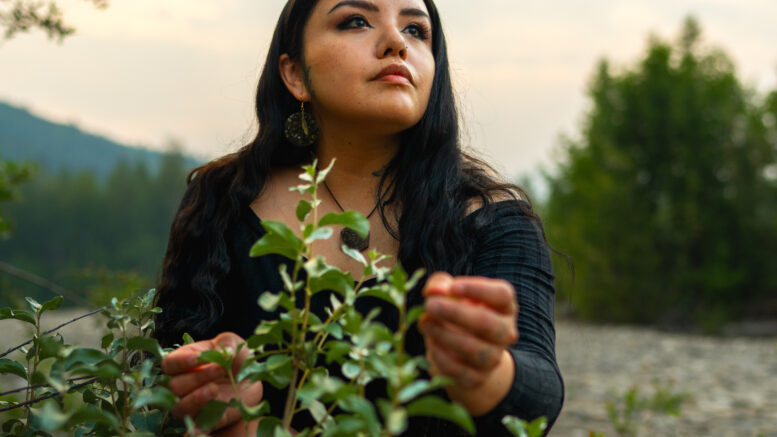
(ANNews) – For Lauren Moberly, entrepreneurship became a path to both independence and cultural preservation. After raising her three children, she found herself wondering what her next steps would be.
“I had my first daughter when I was a teenager,” she said. “For most of my late teens and early twenties, I focused on being a parent. But as I got older, I started wanting to work for myself. I wasn’t sure what that would look like, so I began exploring opportunities to create my own business – and that’s when I turned to the elders and knowledge keepers in my community for guidance.”
Reviving Traditional Soap-Making
That guidance eventually led her to start Fallen Mountain Soap, a business grounded in traditional plant knowledge and ancestral practices. Moberly learned about traditional soap-making from Lucy Wanyandi, the oldest elder in her community and a matriarch of the Aseniwuche Winewak.
“When she passed, she took the traditional soap-making methods with tallow with her,” Moberly explained. “Some of our community members were really sad because that knowledge wasn’t passed on, so nobody knew how to make soap the old, traditional way. When I heard that, it really lit a fire within me, and I decided I was going to teach myself how to do this and bring it back to our community. That’s what I’ve been doing ever since.”
Since 2019, Moberly has been making artisan soap bars and a variety of beauty products using locally foraged ingredients from her traditional territory. “I make a bunch of different beauty products – facial waters, bath bombs, all different types of artisan soaps,” she said. “Tallow soap is animal fat soap. That’s really what got me into soap making. The tallow is animal fat – any type of animal fat – and it’s boiled down in clean water. I work with deer, cows, and all different kinds of animals.”
She has also noticed growing interest in her products. “Since COVID, I’ve seen a jump in popularity, probably because people are looking for more natural ways to include ingredients in their beauty products,” she said.
Sharing History from the Sky
Moberly’s entrepreneurial drive also inspired her work with helicopter tours, combining tourism with storytelling and cultural preservation. Since 2023, she has partnered with Jasper Hinton Air, a non-Indigenous helicopter company, to offer Indigenous-guided tours in Jasper National Park.
“We partnered together to create these Indigenous tours, and I’m present on every tour as the guide,” she said. “I work with clients to share Indigenous history and my family’s history in Jasper National Park. I go into detail about my ancestors’ lives before they were forcibly removed in 1907, when it became a national park. That’s the basis of our tours.”
“We share the culture and history of Jasper National Park and fly to different areas, including my family’s ancestral homestead, which is still standing and is the oldest historical site in the park,” Moberly said. “It belonged to my great-great-grandfather, Ewan Moberly, and my other great-great-grandfathers. Our tours are really about presenting the culture and real history from an Indigenous perspective so anyone can learn and educate themselves.” Through these tours, Moberly is fighting colonialism and the erasure of history by sharing the real story of Jasper National Park from an Indigenous perspective.
Roots and Community
Moberly was raised by her parents, Mike and Emcie Moberly, in a traditional lifestyle. “We lived right in the Rocky Mountains, out in the bush,” she said. “Through hunting, trapping, and really being able to sustain yourself without depending on outside forces – that was how I grew up. I’ve always been in the bush and lived a wilderness life.”
Born in Susa Creek, she grew up in a community that is part of the Aseniwuche Winewak, a non-reserve nation. The Aseniwuche Winewak is made up of seven Indigenous communities surrounding the town of Grande Cache, and none of them are reserves.
In Canada, a reserve is land set aside under the federal Indian Act for a First Nation, governed under federal rules, often with access to specific programs and services. A non-reserve community, like the Aseniwuche Winewak, is not legally designated as reserve land. Its members live on mixed tenure or municipal lands, and governance, recognition, and access to resources are managed differently than for reserve communities.
“Our ancestors never signed a treaty,” Moberly explained. “That makes us a non-treaty nation, which means we haven’t entered into any formal agreements with the Canadian government regarding our land or governance. Our community is made up of Rocky Mountain Cree, Iroquois, Métis, and some Anishinaabe families. We’ve always struggled with defining who we are in government terms. We’re not a reserve or a reserve nation, so our nation has always been in a grey area. We don’t fit in a box.”
Beyond her businesses and helicopter tours, Moberly is deeply involved in advocating for her community’s recognition. “We are currently working toward recognition from the federal government, but I want people to be aware that we are an Indigenous group here, and people are often surprised by that,” she said. “I work with my nation a lot on governance matters. I’ve been very involved in my community, really trying to help achieve that recognition.”
Presenting at the 2026 Indigenous Tourism Conference
Moberly will also be a vendor at the 2026 International Indigenous Tourism Conference, taking place February 17–19, 2026, in Edmonton, Alberta. At the event, she will showcase her soap-making business and Indigenous-guided tours, highlighting how culture, commerce, and community can connect visitors with Indigenous heritage and living traditions.
Preserving Culture, Pioneering Change
Through her businesses, tours, and governance work, Moberly threads together past and present, keeping Indigenous knowledge, traditions, and stories alive for future generations. As part of a growing number of influential Indigenous women, she is paving the way by preserving history in an authentic way and educating both non-Indigenous people and newcomers about her culture through her soap-making and helicopter tours. This work not only strengthens cultural continuity but also supports economic survival through commerce and tourism, making her efforts truly groundbreaking.
Connect with Lauren Moberly on Instagram: @fallen_mountain_soap
which showcases her artisan soaps, beauty products, and Indigenous-guided tour experiences, and Linktree: linktr.ee/fallenmountain with centralized links to her business and social media profiles.

Be the first to comment on "From Soap to Sky: How Lauren Moberly Builds Business and Preserves Heritage"