by Chevi Rabbit, Local Journalism Initiative Reporter
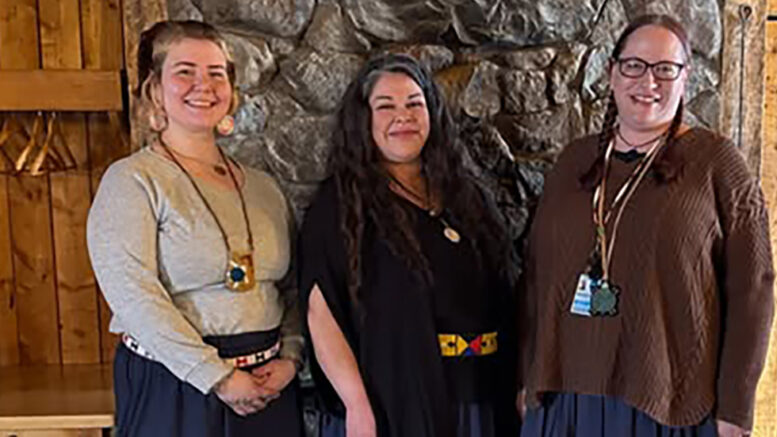
(ANNews) – This winter, visitors at Fort Edmonton Park could hear Indigenous stories that blended culture, tradition, and personal experience. The park’s Indigenous Peoples Experience featured three storytellers – Anna Cousins, Genevieve Olivier, and Lex Wolfe – leading weekend sessions that combine traditional narratives with interactive practices such as shared meals. The program is designed for adults and allows visitors to connect directly with Indigenous perspectives through storytelling. This is a unique experience, where stories about Indigenous life and culture were told by Indigenous people themselves, rather than interpreted through traditional museum curation.
Anna Cousins, a mixed-blood Dene artist, said her storytelling draws on both personal experiences and cultural knowledge. “When I first started the storytelling, I focused more on Dene storytelling, but I didn’t grow up in Cold Lake, so I had to draw from other sources as well, and so a lot of the stories that I tell are personal stories, stories that were gifted to me as a child,” she said. “I grew up – my partner’s Cree – I grew up with Blackfoot territory, and I give my best just to be honest… to speak my truth in a good way.”
Cousins said the sessions also allow her to share even difficult stories. “I think because we are talking about adult stories, I, actually, two weeks ago, I had a couple come in. My first inkling was not to tell my story in its fullness, because it is a story of really hard things, and they were like, ‘No, you have to tell the whole story.’ So, I did,” she said. “The woman and her husband were going through the exact same thing that I had gone through, and that kind of led me to share that story. She brought me aside, and we cried together. She just said, ‘Thank you. I really needed to hear this story,’ because she was really struggling. That, for me – I still get emotional because it was really special – was a really hard moment. But you’re really connected heart to heart with people when you’re given a space to freely talk. People are making heart connections when we’re doing this work… and people are all taking real valuable lessons with them.”
She emphasized that this approach represents a shift from traditional museum practices. “I think the really special thing about our building is that it is our story, our work, and a lot of these events are curated by museum people, whereas ours was curated by the community, by Treaty 6, 7, and 8 communities, and I think that’s really important, because it is from our perspective,” she said. “We have a lot of people who do come through and join us for storytelling, but also just to visit, and they’re learning things that they didn’t have access to before. First and foremost, we’re happy to share, within limits, within reason, as much as we can, so that we can create community and start breaking those stereotypes. I think that’s really special about our place.”
Genevieve Olivier, a mixed-race Anishinaabe storyteller, said communal practices are an essential part of her sessions. “I talk about someone going through healing and how hard it is to do that work on your own, even with support groups, and they actually use some plants to help with that and help people feel better. That’s important to me. To start the session with smudge, if we have time. That gives us our grounding, centers us, and brings us into the moment. It covers all those important things. I appreciate bringing that in whenever possible,” she said.
Olivier highlighted the role of communal meals in building connection. “Conviviality and breaking bread, to me, is really, really important, and sharing a meal in an equal setting is really important. It doesn’t have to be fancy, and we aren’t putting out a big spread. We’ve got pretty average stuff that people might access that just brings comfort –something warm to hold,” she said. “I find visually, scent-wise, and taste-wise – holding all of those things. I’m going to get to hold it, and you’re going to get to smell it, and we’re going to share that drink with everyone sitting, and making conviviality is really important. And when we, like I say, all my relations, that brings us all together.”
Lex Wolfe, a Nehiyaw (Cree) storyteller and educator from Ermineskin Cree Nation, said personal experience is central to connecting audiences with traditional stories. “When we start our storytelling, we always ground it in a story about the self. I talk about my upbringing, being raised in Ermineskin Cree Nation, and my life. I went to school in a white community, and I went to university in a white community, and I had to learn how to walk in both those worlds: the Nehiyaw community and the white community as well. When you tell a story, you’re connecting to all parts of self. A lot of my stories are Wesakechak stories, so they hold lessons, morals, or guidance. Being able to combine that traditional knowledge – in the way the stories have been shared with me – with the Western world of how we talk is really important. You get people of all walks of life. You get people who are reconnecting. You get people who are traditionally raised. And it allows them all to connect with the stories in a good way,” she said.
Wolfe said participation and interaction are key to the experience. “I would say, wow, acknowledge it and be part of it. Allow your spirit to join in the story. This isn’t a Western classroom where we have to stay in our little boxes, because this is community. You laugh differently in the community. You laugh, you go, ‘Oh, laugh, no way, can’t believe that happened.’ There’s interaction. It’s connecting interaction. You get people who’ve never been able to experience that, experiencing true community for the first time when they come to some of these sessions,” she said.
Historically, Indigenous stories in Canadian museums were often curated and interpreted by non-Indigenous staff, which sometimes led to misrepresentation or omission of critical cultural context. Objects, art, and oral histories were presented through institutional frameworks rather than the voices of the communities themselves. Fort Edmonton Park’s approach represents a shift: narrative control is now in the hands of Indigenous community members, allowing for direct transmission of culture, perspective, and lived experience. Cousins, Olivier, and Wolfe said this model allows for storytelling to be gifted to visitors, as participants encounter culture as a living practice, rather than a static exhibit.
The storytelling sessions were offered on Saturdays from January 31 to March 21, 2026, with two 90-minute sessions per day: 10:30 a.m. – 12 p.m. and 1:00 p.m. – 2:30 p.m. They took place in the Indigenous Peoples Experience area of the 1846 Fort building at Fort Edmonton Park. Click here for information about Spring and Summer programming at Fort Edmonton Park.

Be the first to comment on "Fort Edmonton Park Storytelling Connects Visitors to Indigenous Voices"