
By Chevi Rabbit, Local Journalism Initiative Reporter
Conklin, Alberta – In this rural Métis community in northeastern Alberta, housing insecurity continues to shape lives and fracture families. Local resident Joanne Rita Richards shares her story, illustrating the lived reality behind statistics and reports.
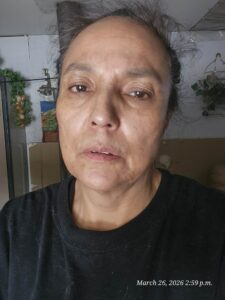
Joanne Rita Richards in Conklin, Alberta. Photo supplied.
“In Conklin, the housing crisis has divided families,” says Richards. “Members have had to move away and give up family unity and our culture for basic human amenities like heat, power, and plumbing. Today it has caused members to become addicts on the streets in urban areas like Fort McMurray, Lac La Biche, and Edmonton.”
A Widespread Housing Crisis
Official community data show that housing insecurity is not isolated. The Housing and Service Needs Estimation Community Report, released by the Conklin Resource Development Advisory Committee (CRDAC) in partnership with the Rural Development Network, found that 86% of survey respondents in Conklin are housing insecure, meaning their shelter is inadequate, unsafe, or unstable.
These conditions affect not just individuals but entire households, including children and elders, reinforcing the urgency of the problem.
“I have seen more homes available in Conklin, but you have to have an income to move into one,” says Richards. “So, most of our homeless are jobless, do not hold a seat on a leadership board, or are just not favored by leadership, so they don’t get to move into an available home. In my situation, I am not favored, so they won’t allocate me a home. To date, Conklin has 5 brand new vacant homes to house our homeless since June last year.”
Social and Cultural Impact
Housing insecurity reverberates through families and cultural life. A lack of stable housing contributes to youth out-migration, interruptions in cultural teachings, and increased vulnerability to homelessness in urban centres.
“People living in these new homes become more judgmental and look down on people who were not allocated one,” says Richards. “I have witnessed lifelong friends break up, seniors stuck in Fort McMurray hospital because our way of living is no longer healthy… they call off-grid unhealthy and unfit to live in, so hospitals won’t let our seniors come home anymore… My mother is one.”
New Housing Arrives, But Gaps Remain
Recent development has begun to respond to housing needs in Conklin. In November 2024, CRDAC celebrated the official opening of 15 new homes to support vulnerable families, elders, and community members. These homes were funded with help from Cenovus and the Government of Alberta, through the Indigenous Housing Initiative, a long-term investment program supporting Indigenous communities near oil sands operations.
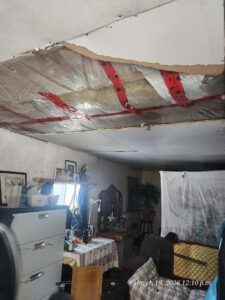
Joanne Rita Richards shared images of her home showing significant damage, which she says reflects the broader housing crisis in Conklin.
“I know about the Cenovus housing initiative,” says Richards. “It helped the ones in Conklin who had homes already get into new homes. But most of our homeless are still homeless.”
The initiative has committed tens of millions of dollars and aims to build hundreds of homes across several First Nations and Métis communities, including Conklin.
Personal Struggles in a Larger Picture
Richards’ own housing experience reflects years of instability and hardship. Despite her efforts to build stable housing, circumstances forced difficult choices.
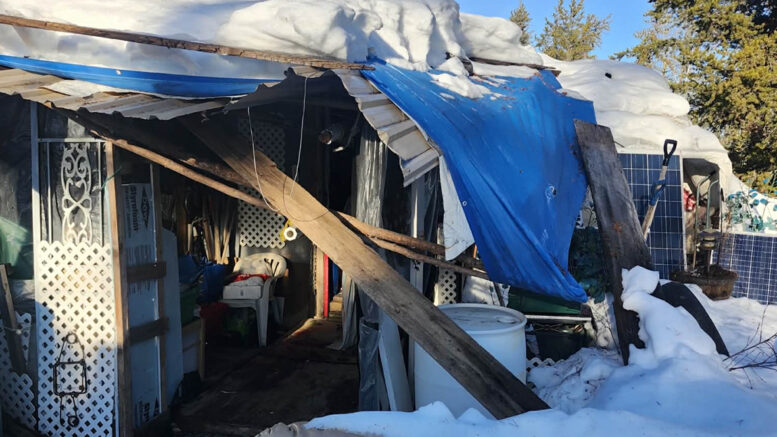
“I am proof. I am still homeless,” she says. “Our leadership board finds excuses not to allocate me a home. Losing my application paperwork is an excuse they use on everyone… I had been fixing up an old mobile home I purchased in 2012 but never completed it… I had to move into it prematurely because the roof caved in the old home. This home I have been living in since 2014. The roof caved in this winter.”
Community Input and Opportunity
Richards also emphasizes the importance of local voices in decision-making.
“We don’t get asked for our opinions or if we have ideas,” she says. “The planning and development is done by one family that sits on the leadership board that Cenovus allocated Conklin’s funding to… Conklin locals are only hired for temp jobs once or twice a month for one day…”
Despite these challenges, she believes community members hold the capacity for solutions.
“We are surrounded by 6 major oil and gas companies,” explains Richards. “Most of Conklin is unemployed, homeless, or both… A new leadership board would open up new opportunities for our locals, bring fresh ideas, and make us all independent again, as well as give us all homes that real homeless need.”
She stresses that local voices and leadership should play a central role in shaping housing and development strategies moving forward.
“We are allowed to attend CRDAC meetings but not allowed to speak,” adds Richards. “If we try to speak, they halt the meeting… I was homeless squatting on Crown land in 2017 and now in 2026 I am still homeless on Crown land.”
Housing as a Foundation for Community Growth
Richards’ story highlights that housing isn’t simply a matter of shelter – it is the foundation for family stability, cultural continuity, and community resilience.
“In Conklin, the housing crisis is more than buildings,” she says. “It’s about our people, our culture, and our future. With the right support and involvement, we can create real change.”

Be the first to comment on "Conklin’s Housing Crisis: Families, Culture, and Community at Risk"