By Chevi Rabbit, Local Journalism Initiative Reporter
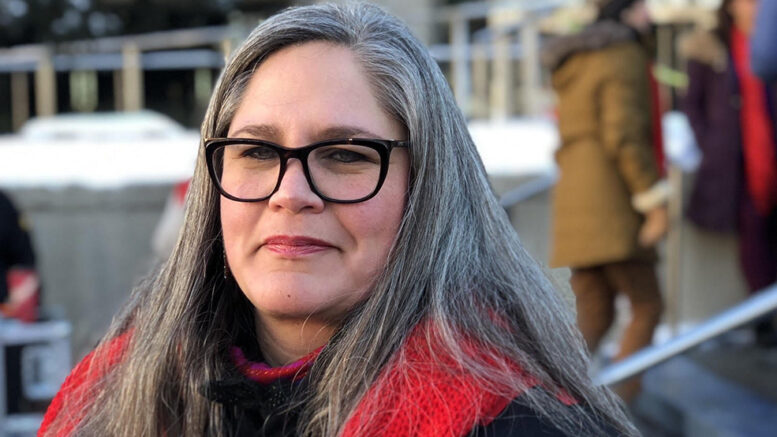
(ANNews) – “I am Red Thunderwoman, my colonial name is Michelle Robinson. I am a Sahtu Dene, a mother, wife, activist, political organizer, podcast host, and have ‘Indian Status’ imposed by the Canadian Government,” Michelle Robinson says. “I have been involved in the political world on the federal, provincial, and municipal levels. I was the first First Nations woman to run for Calgary City Council, and I ran to be a provincial MLA. I have also been a very active volunteer for numerous non-profit events and organizations, school and community events, and politics at the federal level.”
Michelle is also the host ‘Native Calgarian Podcast’ (https://www.nativecalgarian.com/), a platform she launched over eight years ago to amplify Indigenous voices in Calgary and beyond. At the time, podcasts were just starting to gain traction, and the idea of starting her own felt daunting.“At that time, my husband was producing a podcast and he just put the mic in front of me and said, ‘You need to start talking,’” Michelle recalls. “I was embarrassed at first. I thought, why would I do this? But he said, ‘Because you actually have something meaningful to say,’ as opposed to the ranchers’ podcasts or the farmers’ reports or the ones about railways. I thought, really? These things exist? And he said, absolutely, they do. Because at that time, all I could think of was Joe Rogan, and I kept thinking, I’m not Joe Rogan — why would I do this?”
Michelle took the leap — and soon discovered she could easily fill a weekly episode with 45 minutes to an hour of meaningful, thought-provoking content. When the pandemic hit, she began integrating her book club discussions, further expanding her reach and impact.
“Podcasting has been an incredible journey,” she says. “It takes time to grow a following, but I try to educate those who are listening and provide content that matters. That’s what keeps me going.”
For Michelle, the podcast is about more than storytelling – it’s about representation. “From my perspective as a Native person living in Calgary, when I turn on the news, I don’t see proper representation or reflection of our Indigenous communities. While some newscasters will follow me and maybe print the odd story or two, for the most part, our communities aren’t talked about at all. I wanted to put out as much information as I could and go from there. That’s really what I try to do.”
The podcast also serves as a space for healing. “What I really love about podcasting is that it’s actually quite healing to talk about these issues,” Michelle says. “I don’t believe there are proper counselling supports here, so we have to be self-sufficient on our own healing journeys. That’s part of the power of the podcast – it allows me and others to process, reflect, and share in a safe, meaningful way.”
Michelle does not shy away from difficult topics. “In just a few hours, I’m going to be talking about the separation conversation happening in Alberta,” she says. “It’s not something that nationally – or even by many progressives – gets attention. I’m not seeing major news organizations following the money or explaining why this is happening. This is outside interference, yet it’s barely being discussed. People need to understand the forces behind it.”
She stresses the urgency of addressing rising hate. “The anti-Indigenous hate, lies, and disinformation being spread – especially here in Alberta and Calgary – is off the charts. Non-Indigenous people don’t fully grasp the amount of rhetoric, the hate, and the constant barrage of misinformation. And nationally, people who think, ‘Alberta will never separate,’ don’t understand the gravity of what’s happening here. This is not a distant issue – it’s happening now, and it affects real people in our communities every day.”
Michelle also calls out systemic inequities. “The expectation that our treaty chiefs have to invest a single dime in court just to uphold our treaties is outrageous. That conversation hasn’t received the scrutiny it deserves in mainstream media. Decades in court may or may not result in victory, but what matters most is the growing anti-Indigenous hate. Hate crimes are increasing, and more resources are being diverted to deal with these issues instead of supporting the communities that actually need them. Meanwhile, the separation conversation distracts from the real problems we face.”
She emphasizes the responsibility of media and the public. “Both the Truth and Reconciliation Commission and the National Inquiry have very specific calls to action and calls to justice for media,” Michelle says. “I wish non-Indigenous media would follow them – but these calls are for all Canadians. If you spread anti-Indigenous hate on social media, you’re violating the National Inquiry’s calls to justice. There are clear steps every Canadian can take, and we need accountability. We need education. We need people to act responsibly.”
Through the Native Calgarian Podcast (https://www.nativecalgarian.com/), Michelle continues to challenge the narratives that others ignore, holding a mirror to the province’s rising hate while amplifying Indigenous voices. Her work educates, empowers, and heals – creating a space where truth is heard, and Indigenous stories are respected.
“Indigenous voices matter. Our stories matter. And our communities deserve to be seen, understood, and protected,” Michelle says. “If we don’t speak up, no one else will. This is urgent. This is now. And this is why the podcast exists.”

she’s racist shame on her.