
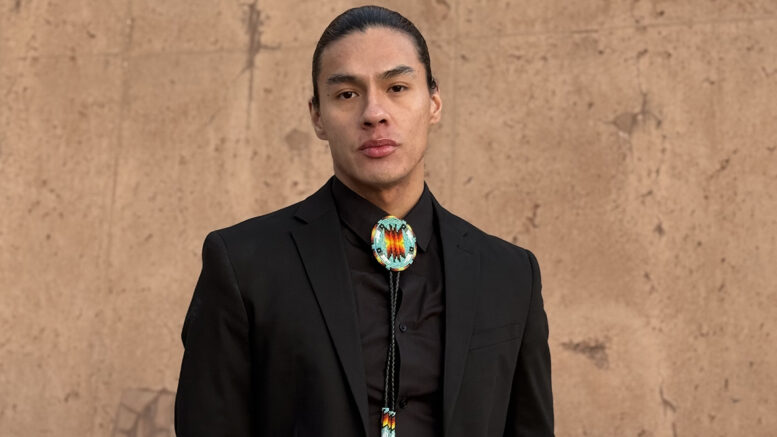
By Chevi Rabbit, Local Journalism Initiative Reporter
(ANNews) – From the northern community of Nisichawayasihk Cree Nation (Nelson House, Manitoba), Tyler Moody carries a story shaped by resilience, culture, and survival. Raised in a family of seven siblings by a single mother, Moody grew up surrounded by instability and addiction, often living in what he describes as “survival mode.”
“I was raised in a family of seven siblings by a single mother, and from a young age I experienced instability, addiction around me, and periods of survival mode,” Moody said.
Between the ages of nine and fourteen, Moody lived with his grandparents, a period he credits as foundational to who he is today. Through them, he learned traditional Cree life skills.
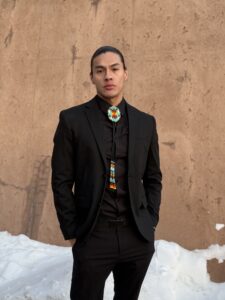
Tyler Moody.
“They taught me traditional life skills – hunting for survival, using medicines from the land, and making clothing from what we harvested,” he said. “Those teachings grounded me.”
Today, Moody is a model, youth mentor, and fashion artist whose work is deeply informed by his heritage. He says culture is not something separate from his career, but the foundation of it.
“My heritage influences everything I do,” Moody said. “It reminds me that our culture is strength, our stories matter, and our people carry knowledge that deserves to be seen and respected.”
Moody’s journey, however, was not linear. He speaks openly about struggles with addiction, mental health, and uncertainty about his future. In his late teens and early twenties, he survived multiple suicide attempts while trying to navigate adulthood without stability or direction.
“There were moments in my life where I didn’t think I would make it,” he said. “I felt lost and unsure of my purpose.”
Healing, Moody explained, came gradually and intentionally. Sports, mentorship, reconnection to culture, and eventually sobriety became key supports. A major turning point came when he moved abroad at the age of 21.
“Moving abroad at 21 was a turning point,” he said. “It forced me to grow, reflect, and take responsibility for my life. Healing isn’t linear, but choosing yourself every day is powerful.”
Moody did not enter modeling or content creation for recognition or fame. Instead, he stepped into those spaces to create representation – something he says was missing in his own upbringing.
“I didn’t set out to become a content creator or model for fame,” he said. “I stepped into those spaces to create representation and to show Indigenous youth that we belong everywhere.”
Mentorship followed naturally. Today, Moody engages with youth through speaking engagements, workshops, storytelling, and one-on-one mentorship. He believes honesty – not perfection – is the most important leadership tool.
“I don’t lead from a place of perfection,” he said. “I lead from honesty. Youth deserve real examples, not unrealistic ones.”
Moody believes Indigenous representation in media and social platforms has grown, but says there is still significant work to be done. For generations, Indigenous stories were told by others, often through harmful stereotypes.
“Social media has given us the ability to reclaim our narratives and show our culture as living, evolving, and strong,” he said. “Representation isn’t just about visibility, it’s about authenticity.”
He says seeing Indigenous people thrive in creative, professional, and leadership spaces can change how young people see themselves.
“When Indigenous youth see people who look like them thriving, it changes what they believe is possible,” Moody said. “Media can either continue old stereotypes or help heal generations.”
His message to Indigenous youth is grounded in both lived experience and hope.
“Your story matters,” he said. “You don’t have to have everything figured out. Hold onto your culture, it will carry you through spaces that weren’t built for us.”
Everything Moody does, he says, is rooted in gratitude – especially for those who never felt seen or heard – particularly in northern communities across Canada.
“My vision is a future where Indigenous youth know their worth, feel pride in who they are, and believe they belong in every room they walk into,” he said.
If his journey helps even one person choose healing, self-belief, or reconnection to culture, Moody believes the work is worth it.
“We are still here,” he said. “We are strong. And the next generations deserve to see that reflected everywhere.”
For inquiries contact Tyler at tylerwwmoody2025@gmail.com.

Be the first to comment on "Rooted in Resilience: Tyler Moody Uses Culture, Creativity, and Honesty to Inspire Indigenous Youth"